
By the time a customer says "let me think about it," you've already spent real money.
You paid for the lead—$150, $300, maybe more depending on the source. You sent a tech or comfort advisor to the home—that's an hour of labor, plus drive time, plus truck costs. You tied up a slot on the schedule that could have gone to a paying job. All in, you might have $400-600 invested in that single opportunity before anyone pulls out a quote.
And then it doesn't close. Not because the customer said no. Not because they went with a competitor. They just... didn't decide.
"Let me talk to my spouse.""We need to think about it.""Can you send me the quote?"
Contact rates drop significantly after the first 24-48 hours, and continue to decay from there. Yet in most shops, there's no clear owner of the follow-up process, no system for handoffs, and no visibility into what's actually happening. Estimates age in the CRM. The investment you already made goes to zero. Revenue that should have closed quietly disappears.
The question isn't whether to follow up. It's who, when, and with what information.
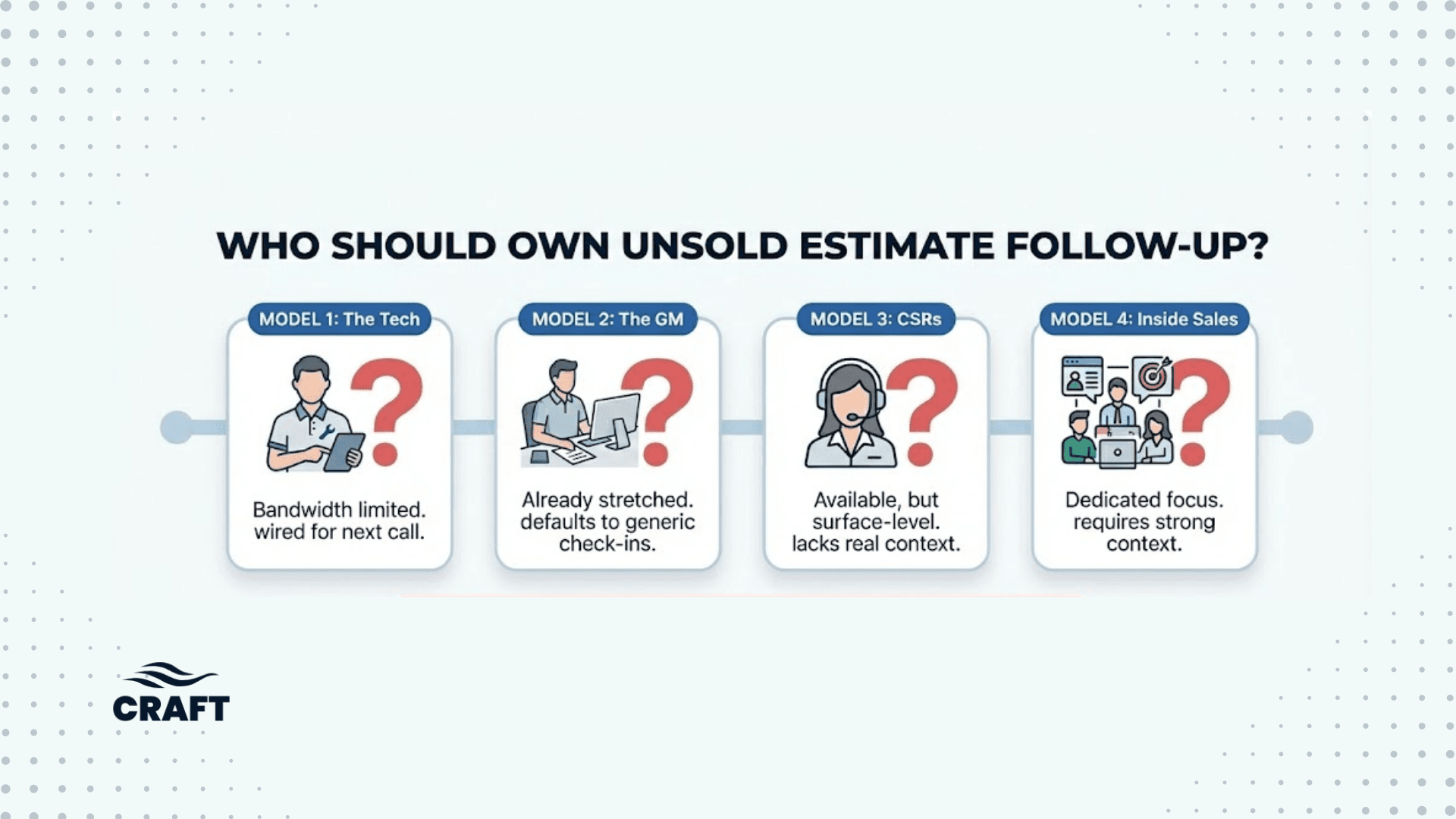
The Four Models
Most operators land somewhere in one of four approaches—each with real tradeoffs.
The Tech or Comfort Advisor Owns It
The logic makes sense. The tech or comfort advisor was in the home. They built the rapport. They know what the customer cared about, what objections came up, whether the spouse was on board, and which options the customer was most interested in.
The problem: techs and comfort advisors are in the field. They're not sitting at a desk making follow-up calls between appointments. Some will text from the truck. Most won't. They're wired to run the next call, not chase the last one.
If they're running 4-5 calls a day, follow-up becomes an afterthought. Context degrades. Leads rot.
- Small shops where the tech is also the closer
- Owner-operators who live and die by every estimate
- Short ownership windows (24-48 hours) with clear handoff process
- No defined ownership period—"the tech owns it" forever, which means nobody owns it
- No system for tracking follow-up activity
- No handoff process when the tech doesn't close
The GM or Owner Owns It
This is the "I'll just do it myself" model. The GM or owner cares more than anyone about every dollar, so they take on the follow-up personally.
The problem: they're already stretched. They're managing operations, putting out fires, dealing with staffing, handling escalations. Follow-up becomes one more thing on a list that's already too long.
And when they do call, they're calling blind. The call becomes: "Hey, just checking in on that estimate we sent over..." Nothing moves.
- Very small shops where the owner is still in the field
- High-value estimates that warrant personal attention from leadership
- As a backup when other systems fail
- Trying to do it all personally instead of building a system
- Calling without context and defaulting to generic check-ins
- Letting follow-up slip when operations get busy (which is always)
CSRs Make 'Happy Calls'
Some operators route unsold estimates to the call center. CSRs check in a few days after the appointment—ostensibly to ask about the customer's experience, but really to nudge them toward a decision.
The problem: CSRs weren't in the home. They don't know the customer was worried about the monthly payment. They don't know the husband wanted to wait until after the holidays.
Without that context, the conversation stays surface-level. "Just calling to see if you had any questions about your estimate." The customer gives a polite non-answer. The CSR marks it as "contacted" and moves on.
- Simple reminders for customers who just need a nudge
- Appointment confirmations and rescheduling
- Initial check-ins before a more substantive follow-up
- Treating CSR happy calls as a replacement for real sales follow-up
- Not giving CSRs any context beyond basic CRM data
- Scripting calls so tightly that they feel robotic
Centralized Inside Sales
A growing number of operators—especially larger ones, multi-location platforms, and PE-backed groups—are building dedicated inside sales teams to own estimate follow-up.
The advantages are real: dedicated headcount, full-time focus, clear accountability, and the ability to scale across locations.
The challenge: inside sales reps weren't in the living room. Without that context, they're just another voice calling to "check in." This is why the handoff matters so much.
- Operators with enough volume to justify dedicated headcount
- Shops with a clear handoff process from field to inside sales
- When inside sales has real context from the in-home conversation
- Building an inside sales team without solving the context problem
- No clear ownership windows or handoff triggers
- Measuring activity (calls made) instead of outcomes (estimates closed)
The Hybrid Approach
The most sophisticated operators don't pick one model—they build a system that combines them with clear ownership windows and handoffs.
Tech or Comfort Advisor
They have context, they have rapport, and they have the best shot at a quick close.
Handoff to Inside Sales
The key: the handoff includes context from the original appointment, not just CRM notes.
Multi-touch Follow-up
Inside sales works the lead with calls, texts, emails—armed with the specific objections and financing details.
Long-term Nurture
Marketing automation, seasonal promotions, maintenance reminders. Stay top-of-mind until the customer is ready.
The Real Question: Context
The tension between these models isn't really about who makes the call. It's about what they know when they make it.
The operators closing more unsold estimates aren't just picking a model. They're solving the context problem. They're capturing what happens in the in-home conversation and getting that information to whoever is doing the follow-up.
When the person calling knows the customer was weighing the 16 SEER vs. the 18, and that monthly payments were a concern, and that the spouse wanted to "sleep on it"—that's a different conversation. That's a closeable conversation.
Questions to Pressure-Test Your Process
No Static Answers
Like most operational decisions, this isn't one-size-fits-all. Some functions benefit from centralization. Others need to stay close to the field. The best operators test, learn, and adjust.
But if your current follow-up process isn't converting, it's worth asking: is the problem effort, or is it information? Is your team calling enough—or are they calling blind?

Craft's AI Sales Engine captures every in-home sales conversation
Surface the context your follow-up team needs—full customer journey, objections raised, financing discussed, decision-maker dynamics—so whoever makes the call has the full picture. Think of it as a co-pilot for your proposal follow-ups.